Silver – Global Supply Can Barely Meet Demand

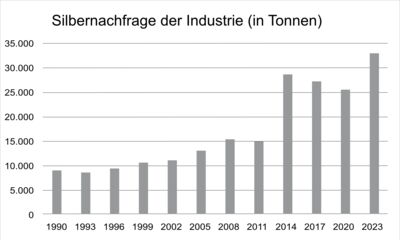
Given robust growth above all in clean energy technologies, silver consumption is likely to reach a record level this year. According to the latest data from the Silver Institute, worldwide mine production was already declining last year and fell back to 830.5 million ounces. Total demand rose to 1,195 million ounces, the second-highest level ever recorded. Forecasts suggest that global silver demand will rise by a further 2% this year.
The silver market is therefore heading for a deficit for the fourth year in a row. Given the requirements of the solar and car industries in particular, the long-term growth trend remains very strong. Set against this is an inelastic supply side, which suffers from mine supply that has grown only very modestly for years. Some of the highest-quality silver mines have already been almost entirely worked out; more than two thirds of production now comes from base metal deposits such as lead, zinc and copper mines – that is, mines that are not primary silver producers. Experts do not expect much to change in this, as it is becoming ever harder to find, permit and build large new silver mines. On top of this, mine operators are increasingly struggling to produce profitably. Taking all costs into account, many silver mines already need 20 to 25 USD per ounce to be viable; compared with 2018 that is a rise of more than 50%. Industrial buyers are currently searching desperately for material and emptying the large warehouses. The stocks recorded by the London Bullion Market Association (LBMA) fell in April to their second-lowest level since records began, while trading volumes on the New York and Shanghai exchanges are close to their seasonal lows.
Given the demand expected, the LBMA stocks are at risk of being depleted entirely over the next two years. The published figures on the physical metal available in fact overstate the quantity on hand, since they also include the holdings of exchange-traded funds.
Author: Markus Grüne
By kind permission of Smart Investor, May 2024 issue
Image: silverinstitute.org